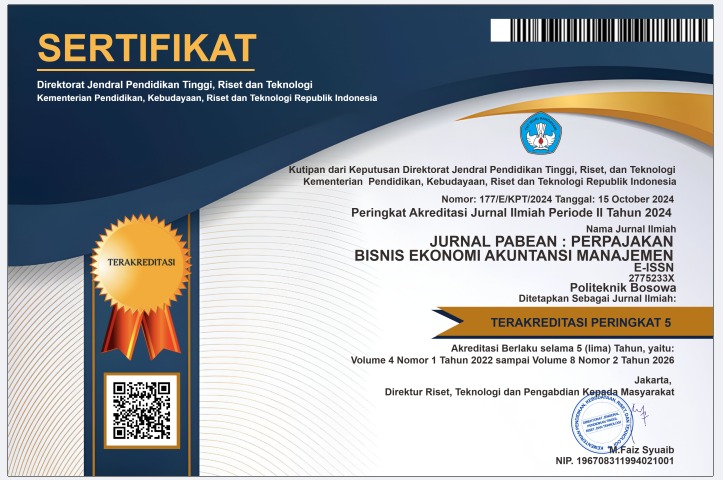
Climate Finance Determinants and The Moderating Effect of Regulation in ASEAN
DOI:
https://doi.org/10.61141/pabean.v8i2.851Keywords:
Climate finance, determinants, regulationAbstract
Main Purpose - The purpose of this study is to examine the impact of governance and financial distress on climate funding in ASEAN countries, as well as how regulation influences this relationship..Method - This study employs a quantitative approach with secondary data from several official sources and use moderated regression analysis (MRA) techniques..Main Findings - The research findings indicate that governance has a major positive impact on climate. Good governance procedures boost the confidence of international investors and donors, facilitating the flow of climate cash. In contrast, financial suffering has a negative effect, which means that growing it diminishes the country's ability to attract and handle climate fund. Theory and Practical Implications - These findings suggest that robust environmental legislation can mitigate and strengthen the impact of governance and financial crises on climate finance. Regulation boosts governance's contribution to climate finance to 27.89 percent and financial distress to 28.04 percent. Novelty - This underlines the significance of improving ASEAN countries' governance and regulatory systems in order to optimize the flow of climate funding. This study also emphasizes the need to diversify financing sources and increase fund management capacity in order to improve the effectiveness of climate finance.References
Afifah, N., & Nugraha, N. (2024). Strategic role of climate finance: A bibliometric analysis. In Proceedings of the 8th Global Conference on Business, Management, and Entrepreneurship (GCBME 2023) (pp. 141–146). Atlantis Press. https://doi.org/10.2991/978-94-6463-443-3
Alshahrani, F., Eulaiwi, B., Duong, L., & Taylor, G. (2023). Climate change performance and financial distress. Business Strategy and the Environment, *32*(6), 3249–3271. https://doi.org/10.1002/bse.3298
Bartram, S. M., Hou, K., & Kim, S. (2022). Real effects of climate policy: Financial constraints and spillovers. Journal of Financial Economics, *143*(2), 668–696. https://doi.org/10.1016/j.jfineco.2021.06.015
Buchner, B., Clark, A., Falconer, A., Macquarie, R., Meattle, C., Tolentino, R., & Wetherbee, C. (2019). Global landscape of climate finance 2019. Climate Policy Initiative. https://www.climatepolicyinitiative.org/wp-content/uploads/2019/11/2019-Global-Landscape-of-Climate-Finance.pdf
Causevic, A., Haque, N., LoCastro, M., Selvakkumaran, S., & Beslik, S. (2023). Assessment of the post-Paris Agreement era: International public climate finance in countries with low governance scores. SAIS Review of International Affairs, *43*(1), 75–99. https://doi.org/10.1353/sais.2023.0002
Cochran, I., & Pauthier, A. (2019). A framework for alignment with the Paris Agreement: Why, what and how for financial institutions? I4CE. https://climatepolicyinitiative.org/publication/implementing-alignment-recommendations-for-the-international-development-
Dangendorf, S., Hendricks, N., Sun, Q., Klinck, J., Hagen, R., & Wöppelmann, G. (2023). Acceleration of U.S. Southeast and Gulf coast sea-level rise amplified by internal climate variability. Nature Communications, *14*(1), Article 1935. https://doi.org/10.1038/s41467-023-37649-9
Giglio, S., Kelly, B., & Stroebel, J. (2021). Climate finance. Annual Review of Financial Economics, *13*, 15–36. https://doi.org/10.1146/annurev-financial-102620-1033-11
Griffith-Jones, S., & Ocampo, J. A. (Eds.). (2018). The future of national development banks. Oxford University Press.
Haryanto, B., Lestari, F., & Nurlambang, T. (2020). Climate change and urban air pollution health impacts in Indonesia [Unpublished manuscript or other type of publication—if published, add source].
Hong, H., Karolyi, G. A., & Scheinkman, J. A. (2020). Climate finance. The Review of Financial Studies, *33*(3), 1011–1023. https://doi.org/10.1093/rfs/hhz146
Kotchen, M. J. (2020). On the scope of climate finance to facilitate international agreement on climate change. Economics Letters, *190*, Article 109070. https://doi.org/10.1016/j.econlet.2020.109070
Lubinga, M. H., & Mazenda, A. (2024). Empirical analysis of the effect of institutional governance indicators on climate financing. Economies, *12*(2), Article 29. https://doi.org/10.3390/economies12020029
Minhas, A. S., Maqsood, N., Shahid, T. A., & Rehman, A. U. (2024). Investment performance in green finance: Assessing the impact of environmental social and governance integration. iRASD Journal of Economics, *6*(1), 27–44. https://doi.org/10.52131/joe.2024.0601.0192
Moau, Y. T., Albada, A., & Huei, S. (2023). Effect of country governance on cross-border renewable energy investment and climate actions in emerging countries. Emerging Markets Finance and Trade, *59*(12), 3813–3827. https://doi.org/10.1080/1540496x.2023.2247139
Nakhooda, S., Watson, C., & Schalatek, L. (2015). The global climate finance architecture. Climate Funds Update. www.climatefundsupdate.org
Nina, A.-A. (2023). Climate finance and governance. In The Oxford handbook of international law and development (pp. 581–600). Oxford University Press.
Rehman, I. U., Shahzad, F., Hanif, M. A., Arshad, A., & Sergi, B. S. (2024). Financial constraints and carbon emissions: An empirical investigation. Social Responsibility Journal, *20*(4), 761–782. https://doi.org/10.1108/SRJ-01-2023-0014
Rossati, D. (2016). International law and the governance of climate finance: Navigating global institutional complexity [Doctoral dissertation or other format—if published, add source].
Steffen, B., & Michaelowa, A. (2022). Policies for climate finance: Status and research needs. PLOS Climate, *1*(10), Article e0000083. https://doi.org/10.1371/journal.pclm.0000083
Varadarajan, D. B., & Chitra, M. (2022). Global climate financing of multilateral development banks: An analysis. Shanlax International Journal of Economics, *10*(2), 64–77. https://doi.org/10.34293/economics.v10i2.4747
Yannick, G. (2023). Financing green and climate resilient infrastructure in ASEAN countries. Environmental Progress & Sustainable Energy, *42*(3), e14097. https://doi.org/10.1002/ep.14097