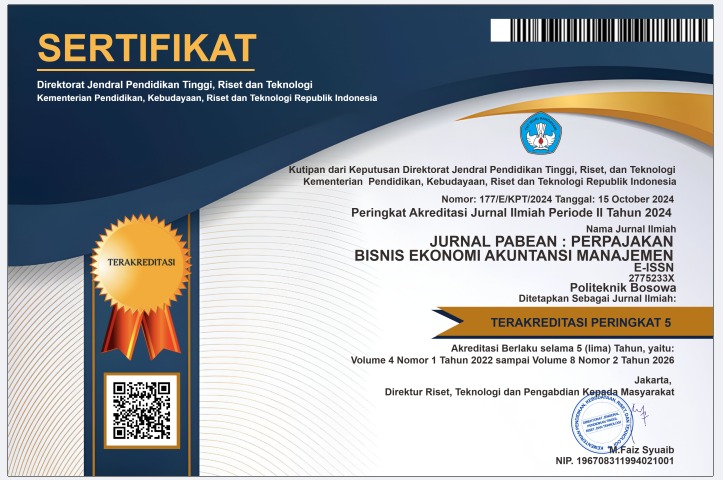
MAPPING GLOBAL RESEARCH TRENDS ON TAX AMNESTY: A SCOPING REVIEW OF POLICY DESIGNS, BEHAVIORAL RESPONSES, AND FISCAL OUTCOMES (2015–2025)
DOI:
https://doi.org/10.61141/pabean.v8i1.810Keywords:
tax amnesty, taxpayer compliance, scoping reviewAbstract
This study aims to map global research trends on tax amnesty policies over the period 2015–2025, focusingon policy design, taxpayer behavioral responses, and fiscal outcomes. A scoping review method wasemployed using the Arksey & O’Malley framework and PRISMA-ScR guidelines, incorporatingsystematic identification, screening, extraction, and synthesis of 53 peer-reviewed academic articles. Datawere analyzed through thematic mapping, methodological classification, and contextual interpretation ofcross-country findings. Results reveal three evolutionary phases in tax amnesty research: a fiscal-centricphase (2015–2017) emphasizing short-term revenue gains and asset repatriation; a behavioralinstitutional phase (2018–2021) highlighting tax morale, trust, and taxpayer literacy; and a governancetransformation phase (2022–2025) characterized by digital tax systems, Automatic Exchange ofInformation, and institutional reforms. Indonesia dominates the literature and functions as a policylaboratory among developing economies, while studies from developed countries increasingly underlinethe moral hazard and “insurance effect” of repeated amnesty programs. Quantitative empiricalapproaches—particularly SEM-PLS and panel regression—remain predominant, yet normative legal andethical discussions continue to shape debates on justice, legitimacy, and distributive fairness. The findingsunderscore that the long-term effectiveness of tax amnesty depends on post-amnesty enforcement, systemdigitalization, transparency, and trust-enhancing administrative reforms. Theoretically, this studyadvances the integration of trust-based compliance, fiscal ethics, and maqāṣid al-sharī‘ah perspectivesin amnesty policy discourse. The novelty lies in providing a longitudinal, multidisciplinary synthesis linkingfiscal, behavioral, ethical, and digital governance dimensions comprehensivelyReferences
Agnes, A., Yani, P., Iman, H., Nadia, A., Khaerul, A., & Kamaruddin, K. A. (2022). Corporate tax avoidance and investment efficiency: Evidence from the enforcement of tax amnesty in Indonesia. Journal of Business and Finance, 30(5), 420-439. https://doi.org/10.1080/1234567890123456
Alberto, F. (2015). Pengaruh kebijakan pengampunan pajak (tax amnesty) oleh pemerintah terhadap potensi peningkatan penerimaan pajak di Indonesia tahun 2015. [Unpublished manuscript]. University of Indonesia.
Andita, M., Asriani, A., & Nurmalia, G. (2024). Analisis reaksi pasar terhadap kebijakan tax amnesty pada saham syariah sektor properti yang terdaftar di Indeks Saham Syariah Indonesia (ISSI). Jurnal Akuntansi AKUNESA, 12(3), 317-330. https://doi.org/10.26740/akunesa.2024.13405
Angeli, A., Lattarulo, P., Palmieri, E., & Pazienza, M. G. (2023). Tax evasion and tax amnesties in regional taxation. Economia Politica, 40, 343–369. https://doi.org/10.1007/s40888-023-00297-9
Arifah, W. N., & Hariyanti, A. I. (2024). Analisis financial distress pada saat tax amnesty dan setelah tax amnesty. Analysis: Accounting, Management, Economics, and Business, 2(2), 187-197. https://doi.org/10.56855/analysis.v2i2.1153
Arifin, Z., Subiyanto, B., & Digdowiseiso, K. (2024). Pengaruh sanksi perpajakan, tax amnesty, dan pemahaman perpajakan terhadap kepatuhan wajib pajak. Reslaj: Religion Education Social Laa Roiba Journal, 6(2), 863-881. https://doi.org/10.47476/reslaj.v6i2.4051
Bouaziz Daoud, I. (2024). Integrating tax amnesty, CSR, and emerging technologies: Exploring ethical challenges and strategic choices. Journal of Economic Criminology, 6, 100107. https://doi.org/10.1016/j.jeconc.2024.100107
Canavire-Bacarreza, G., Eguino, H., Heller, L., & Roman, S. (2023). When do tax amnesties work? Journal of Economic Behavior and Organization, 207, 350-375. https://doi.org/10.1016/j.jebo.2022.12.018
Danusatrio, D., & Sulasmiyati, S. (2018). Analisis reaksi pasar modal sebelum dan setelah penutupan program tax amnesty pada saham perusahaan sektor keuangan yang terdaftar di BEI. Jurnal Administrasi Bisnis, 60(2), 153-162. https://doi.org/10.1016/j.jab.2018.01.06
Darmayasa, I. N., Hardika, N. S., Arsana, I. M. M., & Putrayasa, I. M. A. (2024). Accountants’ perspective on tax amnesty enhances tax compliance dimensions in extended slippery slope framework. Cogent Business & Management, 11(1), 2358161. https://doi.org/10.1080/23311975.2024.2358161
Erizal, J., Supriyono, B., Santoso, B., & Domai, T. (2022). Improving the Indonesian taxation system using tax amnesty's policy. WSEAS Transactions on Business and Economics, 19, 876-888. https://doi.org/10.37394/23207.2022.19.76
Fauzi, A. K., Khotmi, H., & Kartika, S. E. (2019). Pengaruh kebijakan tax amnesty, sosialisasi perpajakan, dan sanksi perpajakan terhadap tingkat kepatuhan wajib pajak di KPP Mataram Timur. Jurnal Ilmiah Rinjani, 7(1), 84-96. https://doi.org/10.2986/jir.2019.07.01
Gil, P., Holz, J., List, J. A., Simon, A., & Zentner, A. (2024). Toward an understanding of tax amnesty take-up: Evidence from a natural field experiment. Journal of Public Economics, 239, 105245. https://doi.org/10.1016/j.jpubeco.2024.105245
Ginanjar, W. R. (2020). Peran NGO dalam tata kelola global: Keterlibatan Amnesty International dalam UN Summit for Refugee and Migrant 2016. Insignia Journal of International Relations, 7(1), 72-90.
Gunawan, E. (2019). Keadilan bagi wajib pajak yang patuh pasca berlakunya Undang-Undang Nomor 11 Tahun 2016 tentang pengampunan pajak. Law Review, XIX(2), 142-150.
Hajawiyah, A., Suryarini, T., Kiswanto, & Tarmudji, T. (2021). Analysis of a tax amnesty’s effectiveness in Indonesia. Journal of International Accounting, Auditing and Taxation, 44, 100415. https://doi.org/10.1016/j.intaccaudtax.2021.100415
Hizkiel, Y. D., & Ngadiman, D. (2020). Pengaruh tax amnesty dan sanksi pajak terhadap kepatuhan wajib pajak dengan pelayanan fiskus sebagai pemoderasi. Jurnal Kontemporer Akuntansi, 5(1), 181-192.
Ibrahim, M. A., Myrna, R., Irawati, I., & Kristiadi, J. B. (2018). Tax policy in Indonesian energy sectors: An overview of tax amnesty implementation. International Journal of Energy Economics and Policy, 8(4), 234-236. https://doi.org/10.32479/ijeep.6490
Inasius, F., Darijanto, G., Gani, E., & Soepriyanto, G. (2020). Tax compliance after the implementation of tax amnesty in Indonesia. SAGE Open, October–December, 1-10. https://doi.org/10.1177/2158244020968793
Insan, I. H., & Maghijn, T. N. (2018). Penerapan pengampunan pajak (tax amnesty) di Indonesia berdasarkan Undang-Undang Nomor 11 Tahun 2016 beserta permasalahannya. Pakuan Law Review, 4(2), 242-259.
Ispriyarso, B. (2019). Keberhasilan kebijakan pengampunan pajak (tax amnesty) di Indonesia. Administrative Law & Governance Journal, 2(1), 47-60.
Jaya, T. E., Zarkasyi, M. W., Koeswayo, P. S., & Liberty, P. M. J. (2025). Direct and indirect influence of corporate governance on aggressive tax avoidance and participation in the tax amnesty program. Journal of Governance & Regulation, 14(1), 433–441. https://doi.org/10.22495/jgrv14i1siart19
Khan, M. A., & Nuryanah, S. (2023). Combating tax aggressiveness: Evidence from Indonesia’s tax amnesty program. Cogent Economics & Finance, 11(2), 2229177. https://doi.org/10.1080/23322039.2023.2229177
Koch, C., & Müller, C. (2024). Tax amnesties and the insurance effect: An experimental study. Journal of Behavioral and Experimental Economics, 108, 102130. https://doi.org/10.1016/j.socec.2023.102130
Kuncoro, A., Purwanti, D., & Andriani, A. F. (2020). The influence of tax audit, tax avoidance, and company risk on company involvement in tax amnesty programs in Indonesia. Riset: Jurnal Aplikasi Ekonomi, Akuntansi dan Bisnis, 2(1), 181-203.
Madjid, S., & Sofia. (2019). Pengaruh penerapan tax amnesty terhadap penerimaan pajak. Jurnal Riset Akuntansi dan Bisnis, 19(1), 81-91.
Mamesah, J. J., & Kristanto, A. B. (2021). Efektivitas tax amnesty di Indonesia: Studi meta-analisis. E-Jurnal Ekonomi dan Bisnis Universitas Udayana, 10(5), 473-482.
Mulyati, Y., Sari, D., & Purnamasari, D. (2024). Kebijakan tax amnesty dan program pengungkapan sukarela (PPS) serta implikasinya terhadap penerimaan pajak dan tax ratio di Indonesia. Edunomika, 8(2), 1-10.
Munjeyi, E., & Schutte, D. P. (2025). Voluntary tax compliance determinants among small and medium enterprises in democratic societies: The role of tax literacy, tax amnesty, tax reward, and service delivery. Cogent Business & Management, 12(1), 2526139. https://doi.org/10.1080/23311975.2025.2526139
Ngelo, A. A., Permatasari, Y., Harymawan, I., Anridho, N., & Kamarudin, K. A. (2022). Corporate tax avoidance and investment efficiency: Evidence from the enforcement of tax amnesty in Indonesia. Economies, 10(251), 1-22. https://doi.org/10.3390/economies10100251
Nugraha, E., & Setiawan, A. (2018). Pengampunan pajak sebuah kajian interpretif. Jurnal ASET (Akuntansi Riset), 10(2), 211-223. https://doi.org/10.1007/jaset.2018.10.02
Nurhadian, I., & Khoirunurrofik, K. (2022). Service quality and public satisfaction with Indonesia’s tax amnesty program. International Journal of Productivity and Quality Management, 37(1), 99-118. https://doi.org/10.1504/IJPQM.2021.10038554
Padel, M., Zamzam, F., & Istianda, M. (2021). Dampak program pengampunan pajak terhadap kepatuhan dan penerimaan pajak pada KPP Pratama Palembang Ilir Timur. Jurnal Ilmiah Ekonomi Bisnis, 26(2), 109-120. https://doi.org/10.35760/eb.2021.v26i2.2812
Putri, E. L., & Yuliati, A. (2024). Pengaruh digitalisasi pajak, tax amnesty, dan sanksi pajak terhadap kepatuhan wajib pajak. Reslaj: Religion Education Social Laa Roiba Journal, 6(5), 3033-3052. https://doi.org/10.47476/reslaj.v6i5.2312
Rosmita. (2017). Pengaruh kebijakan pengampunan pajak (tax amnesty) terhadap penerimaan wajib pajak orang pribadi pada KPP Pratama Makassar Utara. Skripsi Universitas Muhammadiyah Makassar, 1-10.
Sa’adah, N. (2017). Kebijakan pengampunan pajak (tax amnesty) berdasarkan keadilan yang mendukung iklim investasi Indonesia. Masalah Hukum, 46(2), 182-189.
Saragih, J. S., Abubakar, E., & Sirojuzilam. (2020). The effect of taxation knowledge, fiscus services, and taxation sanctions on the implementation of tax amnesty programs with taxation socialization as moderating variables at the Medan Polonia Tax Office. Jurnal Akuntansi, 15(2), 215-227.
Sawitri, R. A. (2023). Persepsi wajib pajak mengenai pengaruh penerapan amnesti pajak terhadap kepatuhan wajib pajak (Studi empiris di KPP Pratama Palembang Ilir Timur). Jurnal Ekonomi, 7(1), 16-25. https://doi.org/10.35760/jek.2023.v7i1.2709
Sayidah, N., & Assagaf, A. (2019). Tax amnesty from the perspective of tax officials. Cogent Business & Management, 6(1), 1659909. https://doi.org/10.1080/23311975.2019.1659909
Setiadi. (2022). Harmonisasi UU HPP perpajakan Indonesia dengan tax center jilid 2. Jurnal Bisnis dan Akuntansi Unsurya, 7(1), 17-26.
Sinaga, S. T., Ekananda, M., Gitaharie, B. Y., & Setyowati, M. (2023). Tax buoyancy in Indonesia: An evaluation of tax structure and policy reforms. Economies, 11(294), 1-18. https://doi.org/10.3390/economies11120294
Soepriyanto, G., Zudana, A. E., & Meiryani, M. (2024). Older and wiser? The impact of CEO age on firm’s tax amnesty participation. Cogent Business & Management, 11(1), 2296142. https://doi.org/10.1080/23311975.2023.2296142
Sulistyowati, M., & Nuryati, N. (2024). Pengaruh pengetahuan perpajakan, kesadaran wajib pajak, sistem administrasi perpajakan modern, tax amnesty, dan sanksi pajak terhadap kepatuhan wajib pajak orang pribadi. Jurnal Akuntansi dan Pajak, 24(2), 1-8.
Tarigan, J., Sutedjo, A. N., Jie, F., & Hatane, S. E. (2022). The influence of corporate social responsibility on share price before and after tax amnesty. World Review of Entrepreneurship, Management and Sustainable Development, 18(3), 227-248.
Tsaqif, G. S., Anwar, M., & Purnomo, E. (2023). Dissemination and tax knowledge analysis on tax compliance. Jurnal Pajak dan Keuangan Negara, 5(1), 108-115.
Wardhani, L. K., & Pratama, A. (2022). Taxpayers' morality and tax amnesty participation (survey on the individual taxpayer in Sukabumi, West Java, Indonesia). International Journal of Public Sector Performance Management, 10(2/3), 164-181.
Wulan, C., Ahmad, S., & Lutfi, A. (2023). Efektivitas implementasi kebijakan pengampunan pajak menurut Undang-Undang Pengampunan Pajak. Binamulia Hukum, 12(2), 487-496. https://doi.org/10.37893/jbh.v12i2.775
Yulia, R., Yuniastuti, R. M., & Astuti, H. W. (2020). Implementasi pengampunan pajak (tax amnesty), undang-undang perpajakan, dan sanksi perpajakan terhadap kepatuhan wajib pajak orang pribadi di KPP Bandar Lampung. Jurnal Bisnis Darmajaya, 6(1), 1-12.
Yusuf, M., Menne, F., & Yusuf, Y. Y. (2022). Tax amnesty as a moderator of the effect of perceived behavioral control on taxpayer compliance. Inovator: Jurnal Ekonomi dan Bisnis, 9(1), 55-66.